The Next Tools of Discovery
Some of astrophysics’ biggest questions are driving the development of a new generation of instruments.

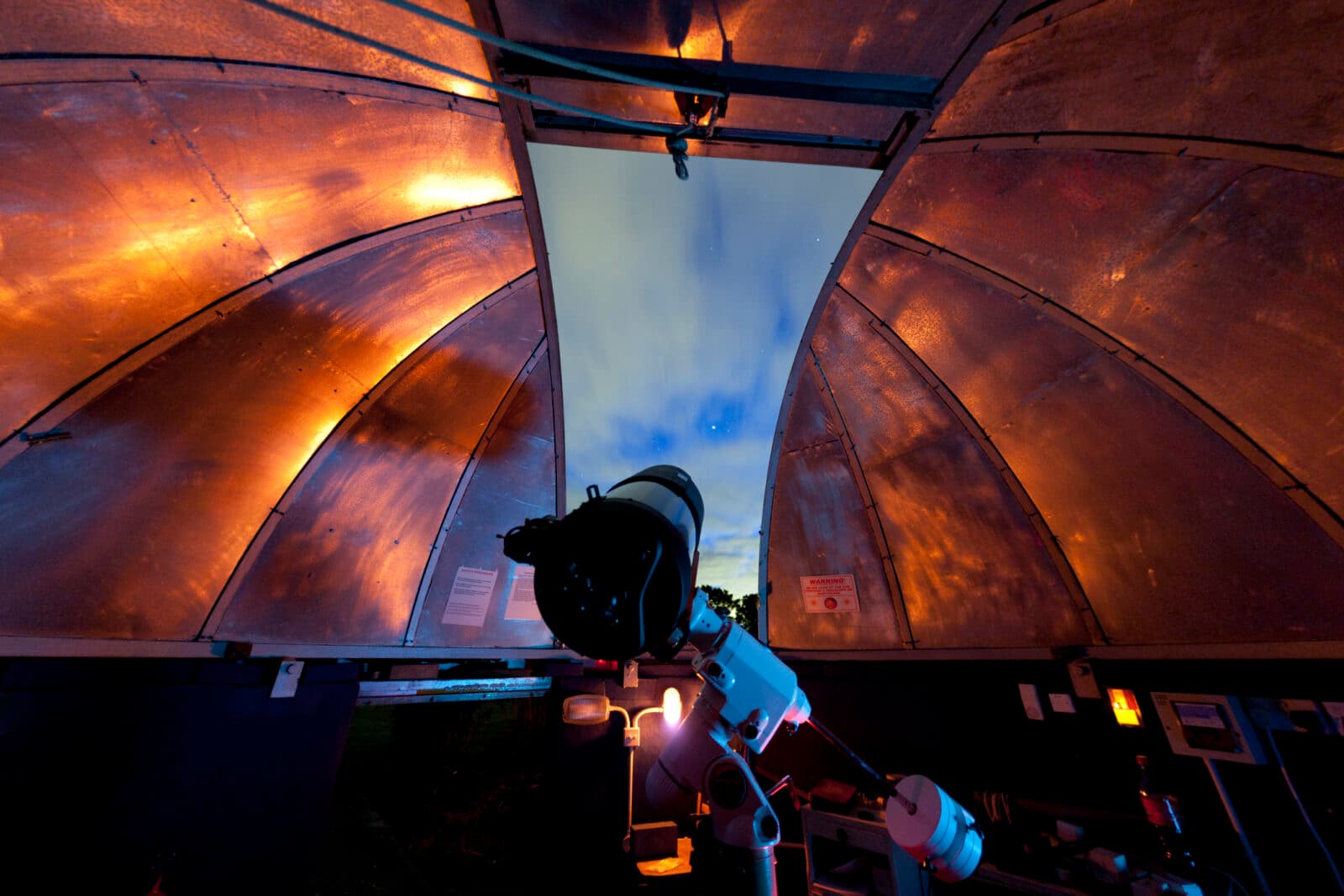
For centuries, advances in instrumentation have expanded humanity’s view of the universe. Thanks to successive generations of instruments, scientists have gazed into dazzling nebulae, witnessed new solar systems form, cataloged billions of far-flung galaxies and detected radiation blasted from exploding stars. Each breakthrough has revealed new questions and new frontiers for exploration.
Yet many of the deepest mysteries of the universe remain unsolved. Questions about how planets form, the nature of dark matter and the earliest chapters of cosmic history continue to push against the limits of current instrumentation. To answer them, researchers increasingly need capabilities that do not yet exist.
“The bottleneck, especially for the smaller aperture telescopes, is that they don’t necessarily have the most state-of-the-art instrumentation,” says Timothy Heckman, the Dr. A. Hermann Pfund Professor in the Department of Physics and Astronomy at Johns Hopkins University. “The way to remain competitive is to be more innovative and come up with novel ways to use them.”
One of the clearest demonstrations of that idea came in 2018. The Zwicky Transient Facility (ZTF) transformed the nearly 80-year-old Samuel Oschin Telescope at California’s Palomar Observatory into one of astronomy’s leading engines for discovering short-lived cosmic events. Its wide-field camera can rapidly scan the night sky for transient phenomena that might otherwise go unnoticed.
“ZTF is proof that you can make an old dog learn really new tricks,” says Shrinivas “Shri” Kulkarni, the George Ellery Hale Professor of Astronomy and Planetary Science at Caltech and a driving force behind the project. “One small telescope, one great idea; that’s a good combination.”
To better understand where new instrumentation might have the greatest scientific impact, The Kavli Foundation convened a group of astrophysicists in 2024, including Heckman and Kulkarni. The group’s discussions provided valuable input that shaped the Foundation’s Instrumentation for Astrophysics program, highlighting the importance of developing new observational capabilities for midsized, ground-based telescopes. In response to insights from the convening and subsequent call for research proposals, several philanthropic funders joined Kavli in supporting the development of new instruments at this scale, including the WoodNext Foundation, Gordon and Betty Moore Foundation, and Kevin Wells.
The program’s awards target several different observational technological bottlenecks, but they share the goal of enabling observations that are currently out of reach.
One effort, which Juan Estrada at the University of Chicago leads and The Kavli Foundation and another philanthropic partner support, is developing a new generation of highly sensitive detectors known as skipper charge-coupled devices (skipper-CCDs). Unlike conventional astronomical cameras, skipper-CCDs can measure extremely faint sources of light with unprecedented precision, opening the door to surveys capable of detecting extremely faint objects such as “rogue” or starless planets drifting through the Milky Way.
Another Kavli-support project led by Pradip Gatkine and Kevin Bundy at the University of California, Los Angeles and the University of California, Santa Cruz, respectively, is developing an astrophotonics instrument suite that manipulates light directly using technologies borrowed from photonics. The approach promises instruments that are smaller, less expensive and potentially more precise than conventional systems while creating new opportunities to study how planets form around young stars.
Though the technologies under development differ, they all aim to extend the scientific reach of the world’s fleet of 2- to 5-meter telescopes, many of which have been in operation for decades. By leveraging this existing infrastructure through innovative instrumentation, researchers can meet today’s demand for new observational capabilities while also testing technologies that may eventually be deployed on future large-scale facilities.
“We have the telescopes, we have the ideas, and The Kavli Foundation and partners have been very strategic in making use of the current assets,” says Kulkarni.
Helping unlock the potential of these future facilities is SuperFIRE, an advanced optical and infrared spectrometer being designed with infrared, optical and ultraviolet capabilities. Like prisms, spectrometers break light into constituent wavelengths, or “colors” (both visible and invisible to human eyes), allowing researchers to determine the composition, motion, distance and physical properties of distant objects.
Led by the Kavli Institute for Astrophysics and Space Research at the Massachusetts Institute of Technology (MKI), the SuperFIRE spectrometer is being designed for potential use by a U.S. Extremely Large Telescope such as the Giant Magellan Telescope. These mammoth facilities will gather several times more light than today’s largest telescopes, requiring equally ambitious instrumentation.
“We’re building a spectrometer for a generation of telescopes that doesn’t yet exist,” said Robert Simcoe, director of the MKI, in a video announcing SuperFIRE in 2024.
Funding from The Kavli Foundation is helping move SuperFIRE from concept to design readiness, enabling MKI researchers to address key technical challenges before construction begins. “There are more risks to be retired when you’re doing something at the bleeding edge like this,” Simcoe added.
Another effort, known as the Via Project, aims to study our own galaxy, the Milky Way, as never before. The Kavli Foundation is supporting researchers at the Kavli Institute for Particle Astrophysics and Cosmology (KIPAC) as they participate in the international Via Project. The collaboration will deploy a pair of powerful spectrographs on telescopes in Arizona and Chile, allowing researchers to capture the whole sky from both hemispheres.
The project will enable researchers to deeply map the cold gas content of the Milky Way; characterize new dwarf galaxies; and investigate the result of ancient collisions in which smaller galaxies were essentially devoured by our own, leaving behind streams of stars strewn through the Milky Way today.
These stellar streams may provide one of the clearest tests yet of prevailing theories of dark matter. Researchers have long wanted to perform more rigorous tests of the dark matter that scientists think resides within the Milky Way, but they have lacked the necessary observational tools. Via will search for subtle “holes” and distortions in stellar streams created by gravitational interactions clumps of dark matter.
“If we find these holes, this will be a huge confirmation of our current understanding of dark matter, and it will completely rule out a whole bunch of alternatives,” said KIPAC Director Risa Wechsler in a video announcing Via.
From upgrading decades-old telescopes to preparing instruments for facilities still on the horizon, philanthropic support can enable researchers to pursue scientific questions that current technologies cannot yet answer.
“Astrophysics benefits from continual innovation, and philanthropic investments by Kavli and our collaborators are helping the field respond to scientific demands that cannot be met by existing technologies,” says Greg Mack, science program officer at The Kavli Foundation. “We’re happy to support the development of tools needed to explore some of the field’s most compelling unanswered questions in new and exciting ways.”
Whether they are extending the capabilities of existing observatories or helping prepare for the next generation of telescopes, the projects highlighted here are part of a tradition that stretches back to Galileo. New instruments have repeatedly expanded humanity’s view of the universe, and the next generation of discoveries will depend on them once again.