Bringing New Eyes to Existing Telescopes
Funding from The Kavli Foundation, the Gordon and Betty Moore Foundation, and partner will expand the capabilities of midsized observatories.

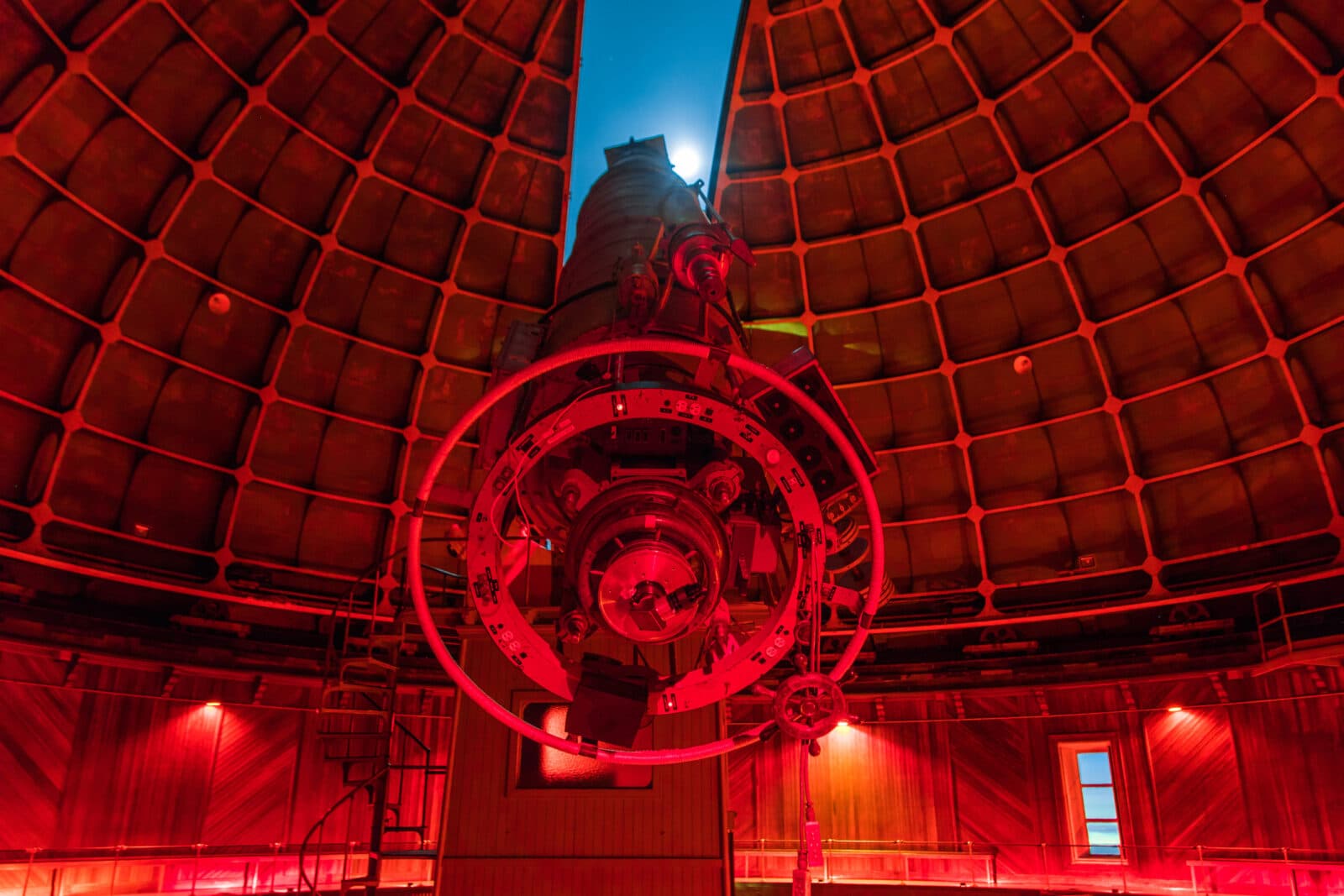
Two university-led projects will receive a combined $2.96 million to advance astrophysics by developing innovative instruments for midsized ground-based optical and near-infrared telescopes.
Philanthropic support for these exciting projects comes from The Kavli Foundation Instrumentation for Astrophysics program, the Gordon and Betty Moore Foundation’s Science Program, and an additional philanthropic partner.
By equipping proven observatories with next-generation instruments, these grants will extend the scientific reach of mid-sized (2- to 5-meter) telescopes; deliver new scientific insights; and demonstrate technologies that larger, flagship observatories could adopt.
“We are excited to expand support for the creation of novel technologies that will invigorate science at existing observatories,” says Dr. Amy Bernard, vice president of science at The Kavli Foundation. “By partnering with other science philanthropies, we hope to accelerate new research and advance technologies that will benefit the entire field.”
The new awards highlight two exciting approaches to advancing astrophysics: improving the sensitivity of astronomical detectors and expanding access to key wavelengths that are difficult to observe from the ground.
A $0.5 million, three-year award will support a team that Dr. Juan Estrada (University of Chicago) leads as the team develops a new imager based on skipper-charge-coupled devices (CCDs). Supported by The Kavli Foundation and a philanthropic partner, the project aims to dramatically improve the sensitivity of conventional CCDs, enabling observations of extremely faint astronomical objects. Through a $2.46 million, four-year award, the Gordon and Betty Moore Foundation will support a team that Dr. Sylvain Veilleux (University of Maryland, College Park) leads to construct a filtering system that will dramatically improve the sensitivity of ground-based near-infrared spectroscopy.
By demonstrating how novel instrumentation can enhance existing telescopes, each project could prove to be transformative for the next generation of ground-based astronomy, leveraging existing platforms to open new paths for discovery.
Deploying the astronomical cameras of the future
A CCD is a silicon chip that converts light into electrical charge. That charge is stored initially in pixels and then read out, digitized and transferred to a computer to create an image. Because of their excellent light sensitivity, reusability, prompt digital output and other benefits, CCDs revolutionized astronomy and astrophysics in the 1980s, taking the place of photographic plates.
Yet CCDs still have ample room to evolve. Estrada and colleagues are advancing a promising technology called skipper-CCDs, which emerged in the 1990s as a means of reducing the electronic noise that limits conventional CCD performance.
With skipper-CCDs, “you can read out the charge of the pixel as many times as you want, and by averaging those measurements, you can reduce the noise,” says Estrada, a professor of astronomy and astrophysics and a senior associate at the Kavli Institute for Cosmological Physics at the University of Chicago.
However, measuring pixels multiple times takes time, and for decades, readout electronics were considered not fast enough to make skipper-CCDs practical for many applications. That changed in recent years. Estrada and colleagues first demonstrated the technology in physics experiments searching for dark matter. A subsequent university- and national lab-led effort adapted skipper-CCDs for astronomical observations.
The astronomy-tailored approach allows for selective processing of pixels and “skipping” those that do not meaningfully contribute to the overall observation. By selectively spending more time measuring the most scientifically valuable pixels, the technology can achieve sensitivity down to the “sub-electron” level, allowing astronomers to detect single photons from extremely faint sources.
For their Instrumentation for Astrophysics project, Estrada and colleagues will build a skipper-CCD instrument on the meter-scale telescope at the Cerro Tololo Inter-American Observatory in Chile. The proof-of-concept instrument will perform a roughly 100-night microlensing survey, detecting the subtle brightening of distant stars caused by foreground objects, such as planets.
The survey’s unprecedented sensitivity to faint, low-mass objects could reveal planets only a few times the mass of Earth, potentially leading to new exoplanet detections. The ultimate goal is to demonstrate scientific returns for skipper-CCDs and provide a pathway toward larger instruments that can bring the technology into broader astronomical use.
“Just in our initial pathfinder phase, we will have an instrument that is operating in a regime that is different from what we have done before in astronomy,” says Estrada. “Scaling up skipper-CCD technology is an incredibly exciting prospect for taking our field into next-generation territory.”
Making valuable near-infrared available to terrestrial telescopes
The second award will support an instrument called the Maryland OH Suppression Infrared System (MOHSIS; pronounced “Moses”), honoring Veilleux’s university affiliation. MOHSIS seeks to resolve the long-standing challenge of bright emission lines from OH (hydroxyl) molecules in Earth’s atmosphere, preventing ground-based telescopes from collecting observations in the near-infrared band of 1.1-1.7 micrometers. The previous workaround for accessing these wavelengths has been to launch telescopes, such as the James Webb Space Telescope (JWST), above Earth’s atmosphere, at tremendous expense and with inherent instrumentation size limitations.
“Advanced instrumentation is needed to push the frontiers of scientific discovery, and we know ground-based near-infrared spectroscopy has long been limited by Earth’s atmosphere,” says Dr. Dušan Pejaković, program director at the Gordon and Betty Moore Foundation. “We were excited to see the feedback Dr. Veilleux’s proposal received from Kavli’s Instrumentation for Astrophysics call. Experts agreed that if successful, this technology could dramatically expand what astronomers can observe from existing facilities.”
To enable ground-based NIR spectroscopy for a host of science objectives, MOHSIS will combine two innovative technologies. The first uses specialized optical fibers to filter bright atmospheric OH-emission lines. The second technology, a fiber optic device called a photonic lantern, maximizes the amount of useful light that the instrument collects. Together, the technologies could dramatically improve the sensitivity of ground-based observations in this important wavelength range.
The project team plans to install MOHSIS on the 4.3-meter Lowell Discovery Telescope in Arizona. There, the instrument could support a wide range of investigations, from solar system studies to observations of distant galaxies. A particularly compelling target is optically dark gamma-ray burst (GRB) afterglows.
GRBs are the most energetic electromagnetic events in the universe, packing as much energy as the sun will produce in its 10-billion-year lifetime into blasts lasting sometimes less than one second. Because of this brightness in gamma rays, GRBs can be detected from extreme distances, allowing astrophysicists to probe some of the earliest galaxies in the universe.
The GRB galaxy hosts available to MOHSIS are expected to be even beyond the reach of JWST, the most powerful space telescope ever launched, as well as the largest planned, future ground-based observatory. More broadly, the precision near-infrared spectroscopy that MOHSIS enables could ultimately prove as transformative as adaptive optics, a revolutionary technology that compensates for distortion caused by Earth’s atmosphere and ushered ground-based astronomy into a new era.
These two awards highlight complementary philanthropic investments in instrumentation for astrophysics that will expand the capabilities of proven observatories.
“There’s an opportunity to advance our understanding of important questions in astrophysics through investment in instrumentation for telescopes at this scale,” says Dr. Greg Mack, program officer at The Kavli Foundation. “With this second round of awards stemming from our initial 2025 call for proposals, we see further proof that these awards are what scientists need to push new frontiers of discovery.”
The Kavli Foundation
The Kavli Foundation is dedicated to advancing science for the benefit of humanity. The foundation’s mission is to stimulate basic research in astrophysics, nanoscience, neuroscience and theoretical physics; strengthen the relationship between science and society; and honor scientific discoveries with The Kavli Prize. Learn more at kavlifoundation.org.
Gordon and Betty Moore Foundation
Gordon and Betty Moore established the foundation to create positive outcomes for future generations. In pursuit of that vision, the foundation advances scientific discovery, environmental conservation, and the special character of the San Francisco Bay Area. Learn more at moore.org.