Cosmology Enters the Precision Era
by Adam Hadhazy
With powerful new tools, scientists are putting the universe’s origin stories to the test

The Author

Cosmology has come an astoundingly long way since the creation myths of antiquity. With the development of ever-more powerful instruments and theories over the past few centuries, the universe’s story is increasingly one that humans can hope to tell.
Speaking to this ambition, a term that’s entered usage in recent decades is “precision cosmology.” It refers to efforts to measure cosmic parameters to finer and finer levels, hewing closer to capturing the reality that nature’s fundamental quantities and laws shape. Precision cosmology is helping to test the best-developed cosmological model, known as Lambda cold dark matter (ΛCDM), while probing other frameworks to determine which best fit the data.
“Part of precision cosmology is to try and crack our cosmological model, to find something that’s inconsistent or to find some other way of looking at parameters,” says George Efstathiou, the professor emeritus of astrophysics (1909) at the University of Cambridge and a member and founding director of the Kavli Institute for Cosmology, Cambridge (KICC). “We have so many of these avenues to still go down and so many questions to answer.”
Building on Planck’s legacy
Efstathiou and KICC have featured significantly in modern precision cosmology for their key roles in the Planck mission. For that experiment, a spacecraft of the same name deeply observed the universe’s oldest light, known as the cosmic microwave background (CMB). This relic radiation from the Big Bang is uniquely rich in information about the origins and evolution of all that exists.
Over its four-year run from 2009 to 2013, Planck measured the CMB in unprecedented detail. Now, a next generation of ground-based instruments is taking CMB studies even further, complementing vast surveys charting millions of galaxies across eons of cosmic history.
One of the latest precision cosmology engines is the Simons Observatory, an international project that includes researchers from KICC and the Kavli Institute for Particle Astrophysics and Cosmology (KIPAC) at Stanford University. The observatory started its 10-year primary mission of observing the CMB with newfound sensitivity in March 2025.
Constructed in the Chilean Andes and consisting of four telescopes, the Simons Observatory is seeking evidence of so-called B-modes — theorized swirly patterns in the CMB’s polarization. These patterns would have been left by ripples generated in the fabric of spacetime by a postulated period called inflation, wherein the infant universe tremendously expanded in size just fractions of a second after the Big Bang. Inflation could explain many observed characteristics of the universe — such as its smooth homogeneity and geometrical flatness — that ΛCDM cannot adequately address.
“The Simons Observatory is a fantastic new facility and is the next big thing in cosmic microwave background research,” says Efstathiou.
The observatory will connect with ongoing CMB studies by the South Pole Telescope, a project supported by the Kavli Institute for Cosmological Physics at the University of Chicago, along with other observatories combing this primordial glow.
Mapping the invisible
Beyond collecting light, some observatories are detecting how the gravity of massive objects — such as galaxy clusters — bends the CMB, a phenomenon known as weak gravitational lensing. Observing this subtle warping is yet another arrow in cosmologists’ quiver, helping reveal the universe’s underlying composition and structure. Efforts continue to hone the technique’s accuracy.
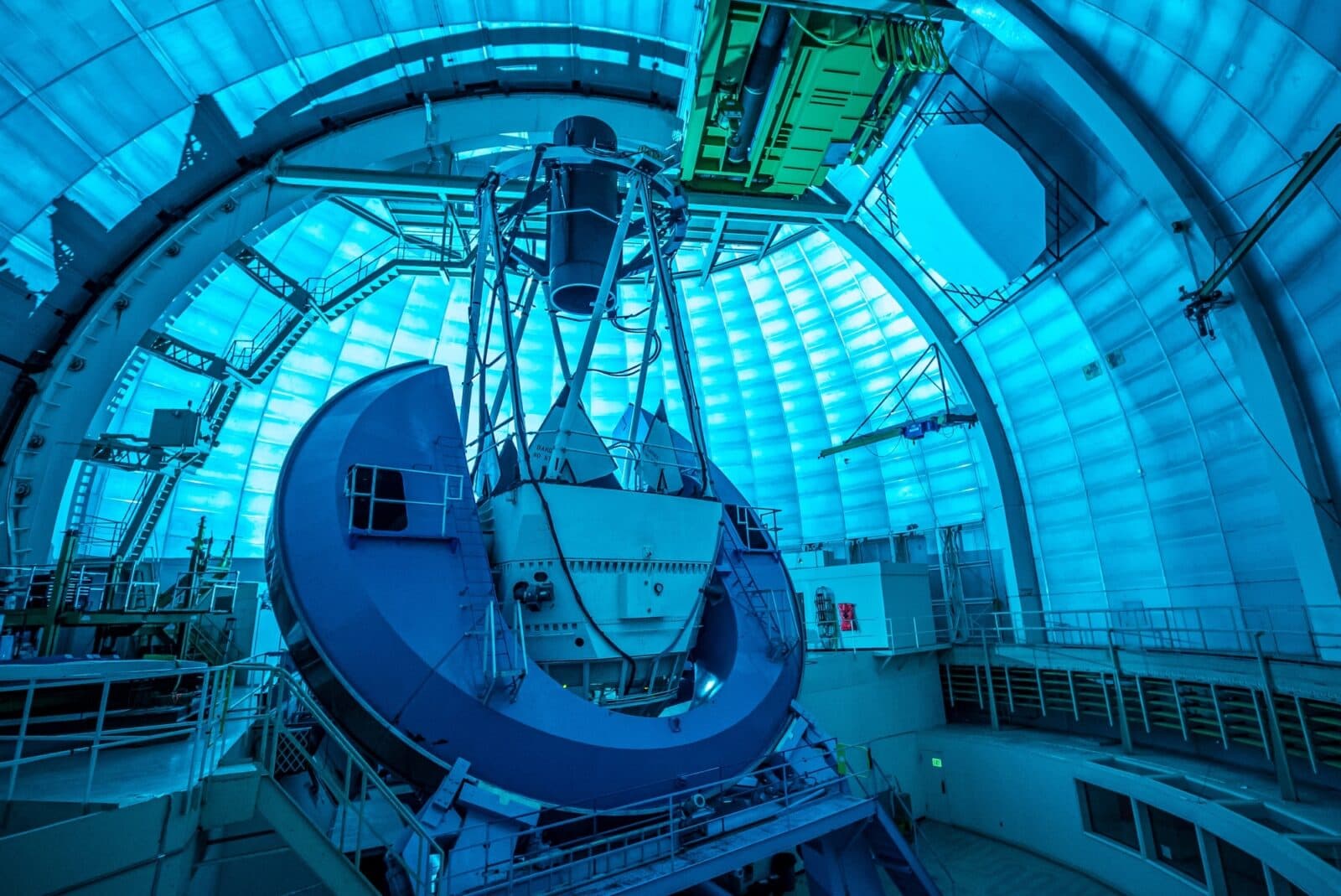
Connected to this lensing campaign is the collection of expansive samplings of groups of galaxies, tracing their distributions chronologically throughout cosmic time. An important player in this precision cosmology regard is the Dark Energy Spectroscopic Instrument (DESI), which also involves researchers at KIPAC. Installed in the Mayall Telescope at Kitt Peak National Observatory in Arizona, DESI is nearing the end of a five-year survey that began in 2021. The survey will rake in approximately 40 million galaxies, cataloging large-scale cosmic structure and compiling the grandest 3D map of the universe to date.
“The state of the art at the moment is to cross-correlate [gravitational] lensing with various other surveys like galaxy surveys, such as DESI galaxies,” says Efstathiou. “That helps tell you things like how the structure of the cosmos can grow.”
Altogether, with these and many other instruments — notably including the ongoing Legacy Survey of Space and Time at the Vera C. Rubin Observatory and the slated Nancy Grace Roman Space Telescope — researchers expect to more confidently measure objective reality, shrinking error bars and sharpening our understanding.
Cracks in the Standard Model
Even as precision improves, immense challenges remain. Efstathiou points out that a critical issue at the heart of precision cosmology is that extant theories do not constrain what values certain cosmic parameters could be. In other words, simply increasing precision — or at least thinking that one has — will not automatically lead to breakthroughs. Progress requires much more analysis, plus healthy skepticism of apparent results.
As a case in point, Efstathiou looks back over the last 40 odd years of progress in building up ΛCDM. The framework has become so well established that it is routinely accepted as “the standard model of cosmology,” in the spirit of the standard model of particle physics.
In a nutshell, ΛCDM posits that the universe is made up of three ingredients: dark energy (around 70% of the mass-energy density of the cosmos); dark matter (about 25%); and finally, everyday matter. Yet, remarkably little is known about the “dark universe.” Experiments have so far merely ruled out possibilities rather than rule anything in. Along with elusive inflation, much of the cosmic story contains only sketches, lacking details and containing shadowy placeholders in lieu of deeply fleshed-out protagonists.
“In the standard model of cosmology, we have these three ingredients — inflation, dark matter, and dark energy — of which we know essentially nothing; we have no idea from the fundamental physics point of view really anything of substance about those ingredients,” says Efstathiou. “We’ve measured things to very high precision that we don’t understand yet.”
Efstathiou and others hope that continued innovative interrogation of the cosmos will yield paradigm shifts. The last big shift came in 1998 with the discovery of dark energy via observations of surprisingly faint, distant stellar explosions.
Now, nearly 30 years later, hints of a potentially “evolving” dark energy, whose strength and impact have changed over cosmic history, have recently emerged from DESI analyses. Efstathiou cautions, however, that it is far too soon to suggest that a rewriting of ΛCDM is in order.
With any luck, the quest for greater cosmological precision will prove successful.
“That’s the future for cosmology, and it’s great that KICC and other Kavli astrophysics institutes will have major involvement,” says Efstathiou. “We will have to be lucky that nature has something that is accessible to us, and it could take generations, as the history of science has shown us. But it’s a really big deal to try and understand what’s out there.”